
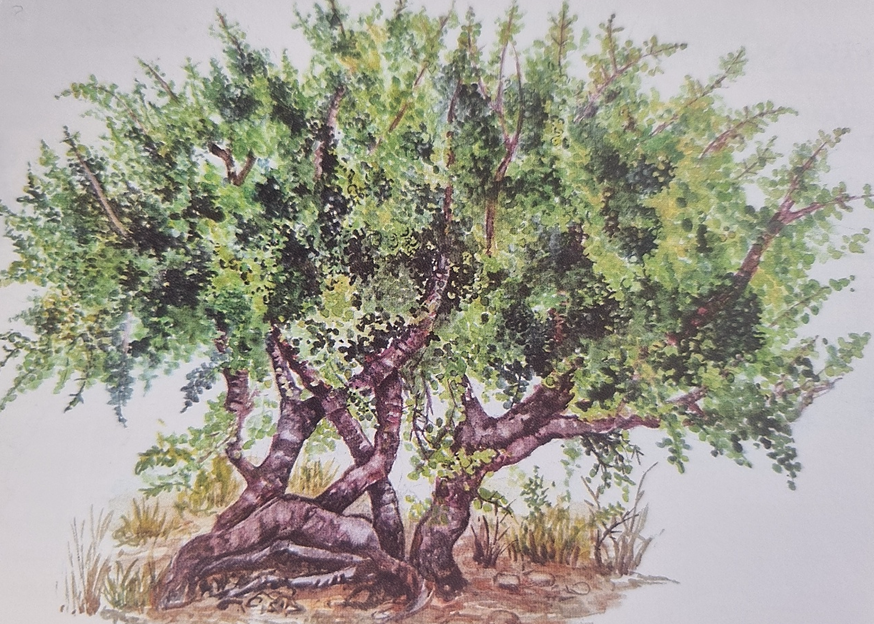
Source: SAPPI Tree Spotting KZN-Natal and Eastern Cape Jacana Media 2013
By Alistair Collier | The Business of Golf Magazine
Dear Club Manager, Director of Golf, Course Superintendent,
YEAR END GREETINGS, ESG SUSTAINABILITY AND THE HUMBLE SPEKBOOM
During the break over December and January, many of the country’s golfers will be visiting different parts of South Africa and may be planning their golf within areas such as the Cape floristic kingdom, with its famous fynbos, or even in the Savannah bushveld area with its famous trees i.e., the baobab, and grasses such as the red thatching grass.
However, this holiday season, one wonders how many golfers traveling through the Karoo will really appreciate the impact of the humble spekboom, and the work being carried out, within the Eastern Cape Albany thicket areas, to reintroduce this plant species, which over the years has been decimated by urban development, and agriculture – goats for one love spekboom!
Many people do not notice, or even appreciate what has been lost over time, as has been the case with the spekboom, which provided a closed canopy, and micro-forest comprised of unique plant species, which support birds, insects, small animals and mammals.
So, as a thought, why not consider how the possible propagation of the humble spekboom at your golf club, can support the recovery of this marvellous plant species?
At the same time the initiative would neatly complement your club’s ESG sustainability journey, and in particular the three pillars of sustainability; “E”, “S” and “G”.
In terms of “E”, think about the benefits of spekboom, namely its carbon storage ability (a single hectare can store roughly 6 tons of CO2 a year, and may eventually generate revenue through high integrity carbon credits), or smart water usage, or enhancing biodiversity revival – spekboom shades leaf litter, and builds a micro-climate, which gives other plants a chance to germinate, while providing food and habitat for wildlife.
In terms of “S”, spekboom has a cultural value, in that it is deeply embedded in our region’s indigenous knowledge and heritage.
In terms of “G”, consider re-imagining golf course employment roles as creating green jobs and work, which is sustainable not only from planting and land preparation for spekboom, but also for community education, which may lead to awareness campaigns on the benefits of spekboom for the community, while simultaneously building on the ESG sustainability narrative about your golf club and the game of golf in general.
This approach is not a pipe dream.
It is already happening, where recently the United Nations environmental programme (UNEP) named South Africa’s thickets restoration programme, as one of its world restoration flagships.
Several organisations are involved in this flagship programme, one of which is the Return to Thicket organisation based in Tokai, Cape Town, with their primary restoration area around the Fish, Sundays and Gamtoos rivers.
In this regard there are at least 10 golf clubs that fall within this primary restoration area, which could embrace the UNEP flagship programme, while in addition many clubs throughout South Africa could also implement their own restoration programmes.
Are there any challenges with planting, and looking after spekboom?
Not really, it needs minimal water (it doesn’t like to have ‘wet feet’ to use a gardening phrase), and is hardy, so it will pretty much look after itself.
As the year draws to a close, a big thank you to all those clubs that have embraced their own ESG Sustainability journeys, and we wish all clubs, their management teams and members a restful year-end break, a blessed Christmas and a positive 2026.
If you have any queries, why not contact the John Collier Golf through our website or via email ajcollier@telkomsa.net?
Yours in Sustainable Golf
JOHN COLLIER
If you have any questions, please do not hesitate to email ajcollier@telkomsa.net or visit the John Collier Golf website at www.johncolliergolf.com