
By Alistair Collier | The Business of Golf Magazine
Alistair Collier offers a delegate’s perspective on the recent Club Managers Association of Southern Africa’s (CMASA) AGM and Conference, which was hosted by Arabella in the Western Cape, and which sees, naturally enough given Alistair’s John Colier Survey, the conference through an ESG lens.
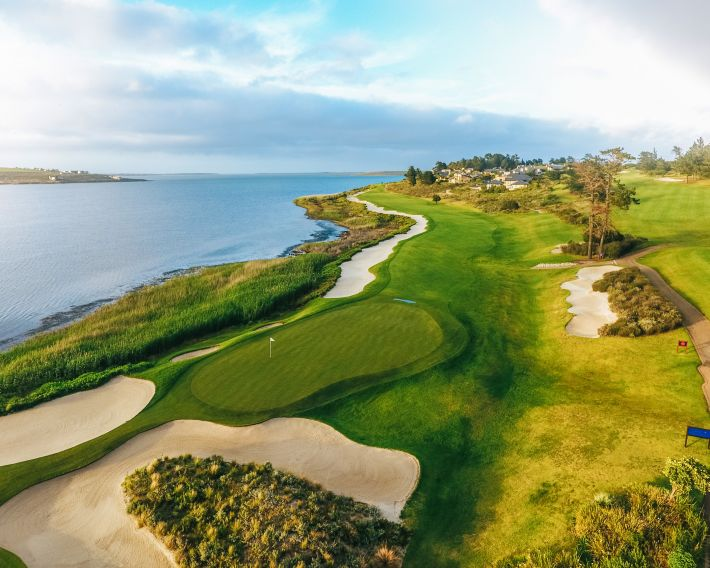
CMASA’s 2026 Conference was held at Arabella from 23 to 25 August 2026, bringing together club managers, industry professionals, partners and thought leaders from across Southern Africa for three days of golf, governance and a packed keynote programme.
Summing up on the final afternoon, MC Brent Lindeque identified five themes running through the conference: people, intention, the small things, adaptability, and experience.
Incoming CMASA Chairperson Sue Smith closed proceedings by reminding delegates that exceptional member experience “must be an intentional goal” and that developing the next generation of club managers, through deliberate succession planning, is a leadership responsibility, not a by-product.
It was, she said, a reminder that CMASA is “more than an association” — it is a community supporting the club industry.
Sustainability was never actually billed as a headline topic at Arabella, and yet when I run an eye — or, as it turned out, an AI — across the two days of keynotes, the language of sustainability, and its three pillars (environmental stewardship, social responsibility, governance and financial excellence) surfaced in presentations at least once every six minutes.
The following summary looks look at how those themes played out across the conference’s keynote speakers, and why they matter increasingly to golf clubs.
ENVIRONMENTAL STEWARDSHIP: The Quiet Pillar
Of the three, environmental stewardship was the most sparsely represented on the programme — but a modest through-line still emerged.
The clearest marker for this was the 2026 CMASA Sustainability Award, won by Atlantic Beach Estate for achieving full marks across best practices, data collection and highlights.
It was CMASA’s one explicit environmental recognition mechanism on the programme, and a very encouraging sign that sustainability practice is beginning to be measured, not just talked about, at club level.
The same theme also surfaced obliquely in the Tuesday keynote speech – “Behind the Scenes” – in which Pierre van Vuuren, General Manager of The Club at Steyn City, and Chris Bentley, SVP and Global Managing Director of LIV Golf, discussed staging a world-class tournament from both a host-club and a tour perspective.
Alongside the headline economic numbers — a total economic impact of R800 million, with 95% of suppliers sourced locally, and 13.5 billion social media views — the pair touched on the close working relationship between LIV’s agronomy team with the R&A on course and turf management team during the event, a reminder that even an elite-level tournament golf now treats agronomic and environmental planning. as integral to the production, not an afterthought.
Underneath both of these elements was a quieter data point from the Monday industry-benchmarking session, presented by Francois Swart and Sue Smith: core capital expenditure — largely course and facility maintenance — held at 58% of total club capex even, as the overall capex-to-revenue ratio across the industry fell from 14% to 7%.
In plain terms, clubs are spending less overall, but course and grounds maintenance is one of the last places that spend is being cut.
Whether this reflects a deliberate environmental priority, or simply that course maintenance is the hardest cost to defer, is an open question — but it is a trend worth CMASA tracking more formally, alongside the ‘214 clubs now running sustainability initiatives’ figure raised informally during the Monday “Career Speed Dating” session.
SOCIAL RESPONSIBILITY: By Far The Loudest Pillar
If environmental stewardship was the quiet pillar, social responsibility was by far the loudest — and it ran through almost every keynote on the programme.
Andrew Wolhuter opened Monday’s speaker line-up with “JUMP”, built around the idea that connection is a learnable skill, rather than an innate trait: Self-Awareness plus Valuing Diversity plus Building Rapport plus Co-Creation equals Connection.
He introduced the “Four Horsemen of the Relationship Apocalypse” — criticism, defensiveness, stonewalling and contempt — as a practical diagnostic for staff, member and committee friction, and cited research suggesting only around 15% of people are genuinely self-aware.
That people-first thread continued through the day.
Peach Olive’s “Member Xperience” set out five pillars of the member journey — awareness, consideration, purchase, post-purchase, and loyalty/advocacy. She argued that in 2026, a sense of belonging is a baseline expectation, not a differentiator.
The “Daisy syndrome” story illustrated the risk of staff believing that they deliver good service,
when the members experience is quite different,
while the concept of “unreasonable hospitality”,
was offered as a low-cost, high-impact way to close that gap.
The conference’s most striking personal keynotes also fell squarely under this pillar.
Joey Evans, in “Para to Dakar”, recounted breaking his back in a 2007 racing accident, years of rehabilitation, and his eventual completion of the 2017 Dakar Rally — including a day on which his bike was run over mid-race.
He closed with the line that has stuck with delegates since: “You didn’t come this far to only come this far.”
His closing reframe was that emotional hardships such as loss, financial ruin or depression can be as debilitating as physical injury, and often less visible.
Evans’ closing note set up Thuli Kakaza’s “Healing & Dealing” on the following day.
Kakaza, a trauma-informed psychosocial support specialist, named three specific leadership wellness risks — burnout, chronic stress and executive fatigue — and offered a three-phase heal/deal/reveal framework for senior leaders, treating leader wellbeing as a systemic issue that propagates through “the entire system, including the workplace and family”, rather than a private struggle to be managed alone.
Anne Vermaak of GolfRSA and Dietrich Uys of the PGA of South Africa, brought hard data to the same pillar, presenting a joint “discovery to belonging” growth strategy built on tools such as Golf Adventure (a Roblox-based golf experience), and simplified Kickstart Rules for beginners.
Survey data showed the average South African golfer is 41, with 44% under 35 and 38% female — figures that dovetail with the Monday benchmarking session’s finding that female club membership grew 22% against a 3% overall net growth figure, the clearest quantified diversity signal to come out of the conference.
Running through several of these sessions was Jeffrey Kreafle, CEO of Congressional Country Club in the United States, who gave three separate presentations across the two days.
In “Secure the Job of your Dreams”, he described being the least qualified candidate on paper for his own CEO role but the most prepared, thanks to a personal interview-preparation system, and advised delegates to pick up a new skill every year, noting that “income rarely exceeds personal development.”
It was a message that reinforced, from the individual’s side, the same ‘investment in people’ theme running through the rest of the pillar.
GOVERNANCE: Demonstrated More Than Discussed
Governance was less a topic on the programme than something the conference simply modelled.
The AGM itself — CMASA’s 71st — ran through notice, quorum (15 members), a moment of silence for deceased members including Rob Heger, minutes approval, and an uncontested, but properly signposted committee election, culminating in a clean chairperson handover from outgoing chair Francois Swart to Sue Smith.
Carel du Toit’s Tuesday session, “AI — What Leaders Need to Know”, extended governance thinking into new territory, calling for formal AI policies, a named accountability owner, and continuous staff training, alongside a striking healthcare example, in which AI was shown to have cut patient file retrieval time from six hours to 15 minutes.
Read alongside the LIV Golf case study’s multi-stakeholder coordination — club, tour, government, security, broadcast — at a scale most member clubs will never individually manage, it was a reminder that governance now stretches well beyond the AGM’s agenda.
It was Jeffrey Kreafle’s three sessions, taken together, that made the strongest case for treating culture itself as a governed, strategic system, rather than a soft HR add-on.
In “Culture: Q&A”, alongside Francois Swart, he described hiring and firing explicitly “by core values”, a structural shift from a traditional, to a division system to sharpen accountability, and a discipline of over-communicating with the board during difficult periods.
In “Lessons Learned on the Trails” — built around his own completion of a 100-mile race through the Sonora Desert, despite suffering from a bacterial infection and sepsis — he distilled the same discipline into a personal-leadership formula: “process goals over outcome goals” and daily accountability trackers.
Taken together with “Secure the Job of your Dreams”, hiring itself became a governed, repeatable process rather than an ad-hoc decision.
FINANCIAL EXCELLENCE: The Clearest Numbers of the Conference
Financial excellence produced the conference’s hardest data.
CMASA’s CEO Roxanne Reeves reported revenue growth of 83%, from R4.4 million to R5.9 million, with a R580,000 surplus for the year to 28 February 2026, and premium membership up from 35 to 70 clubs since 2021 — describing an association, and by extension an industry, in an increasingly capital-disciplined position.
That picture was reinforced by the Monday benchmarking session: profitability ranging from 4% (clubs on R0–15 million revenue) to 11% (R50 million-plus), cash reserves up from 18% to 25%, and capex-to-revenue falling from 14% to 7%, even as absolute capital spend held near R2.7 million.
The LIV Golf case study added scale to the same pillar, with its R800 million economic impact, and 95% local-supplier figure illustrating that financial excellence now extends well beyond individual club balance sheets into event-hosting as a regional economic driver.
Jeffrey Kreafle’s 90%-hiring-success target, discussed in “Culture: Q&A”, added a leadership-quality lens that the benchmarking numbers alone cannot capture: a deliberate, if unquantified, strategy to reduce the real cost of mis-hires and staff turnover.
SUSTAINABILITY: A Gentle Reminder, Delivered 6 Minutes at a Time
None of this was framed as an ESG conference, but delegate after delegate, and keynote after keynote, arrived at the same three pillars from different directions — grounds and turf care, staff and member wellbeing, procedural governance, and disciplined finances — suggesting sustainability, in the fullest sense of the word, is becoming embedded in how the Southern African club industry thinks about itself, whether or not it uses the word out loud.
Finally, Roxanne Reeves and her team deserve real credit for a slick, well-run conference, as does Bevan du Plessis and his team at Arabella for their hospitality throughout.
CMASA and its delegates can now look ahead to 2027.
If you have any questions, please do not hesitate to email ajcollier@telkomsa.net or visit the John Collier Golf website at www.johncolliergolf.com