
By Alistair Collier | The Business of Golf Magazine
INFORMATION BRIEF 142
Dear Club Manager, Director of Golf, Course Superintendent,
For nineteen years, the John Collier Survey has been doing something no other body in South African golf attempts; it asks, club by club, a question the industry doesn’t always want to be asked or have answered: how sustainable are we in real terms as a sport?
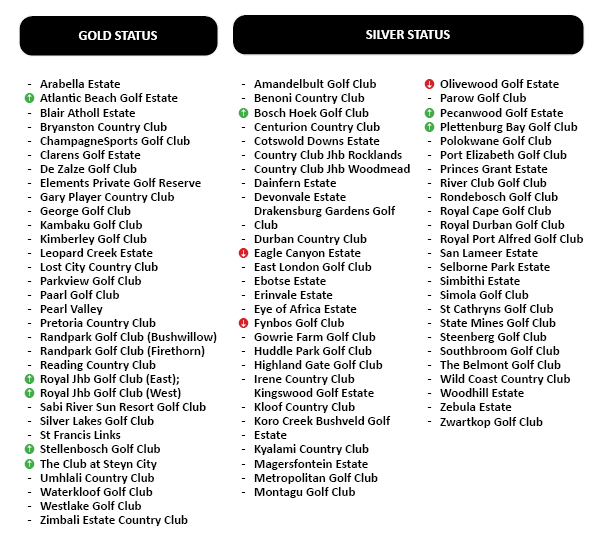
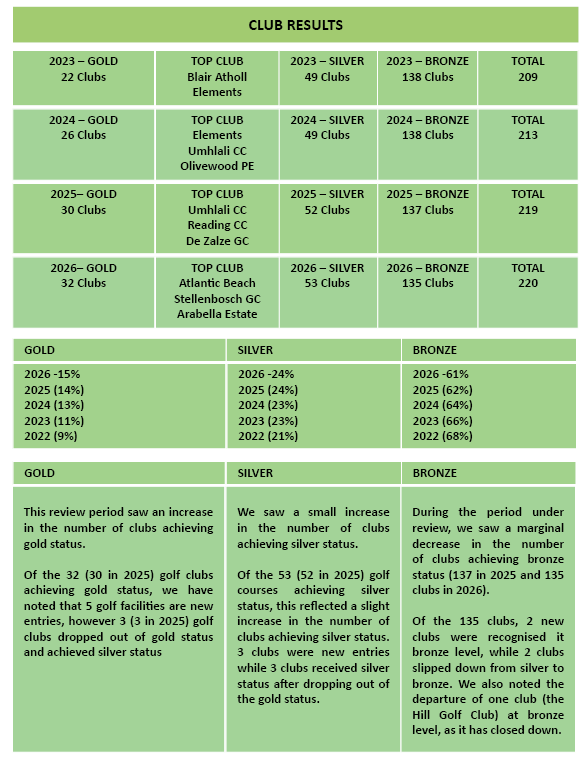
The headline number is gold: In 2026 thirty-two clubs achieved gold status up from 30 in 2025, 26 in 2024, and 22 back in 2023 – a steady four year climb, which shows no sign of peaking.
Five clubs earned gold status for the first time, which demonstrates meaningful change, and that the top rungs of the ladder are not always being occupied by the same established names, and while three clubs dropped out of gold, the net movement is unmistakably upward.
The silver level told a similar, albeit lower key, story, wherein fifty-three clubs hold silver status, which is a modest rise from 52 in 2025.
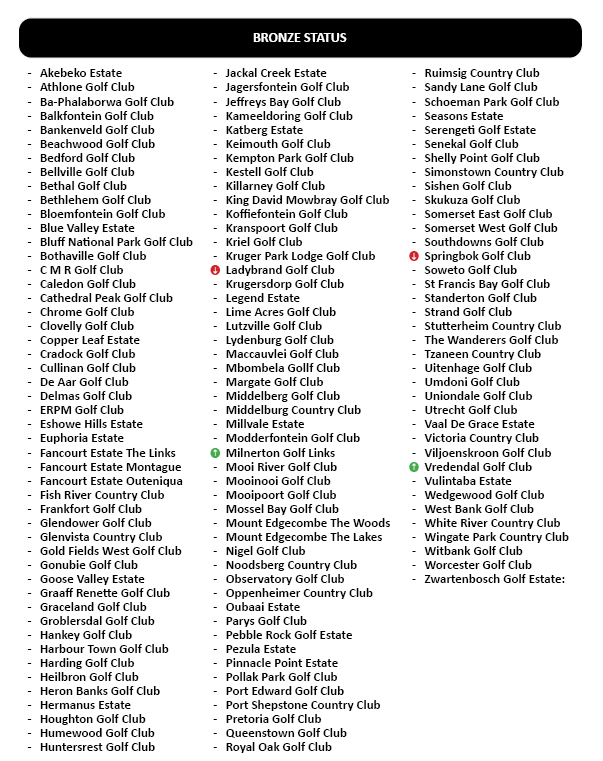
Bronze experienced a small contraction from 137 clubs to 135, which in isolation might look like a step backward, until seen alongside the gold and silver numbers, which show that clubs aren’t dropping out of the system but moving up through it.
Seen in combination, the table’s three-tier shape has moved in a direction the survey has been hoping to see for years; thickening at the top, a gentle widening in the middle, with a thinning at the entry level, as clubs graduate upward.
In terms of the survey data published in March 2026, participation across South Africa’s golf clubs reached just over forty-six percent. This number warrants more credit than it gets, because this is a voluntary survey, with no regulatory requirement compelling a club to open its books, etc., to outside review.
Having nearly half the country’s golf clubs doing exactly that, reflects very positively on how seriously the industry has come to take its environmental stewardship, social responsibility, and governance excellence footprint.
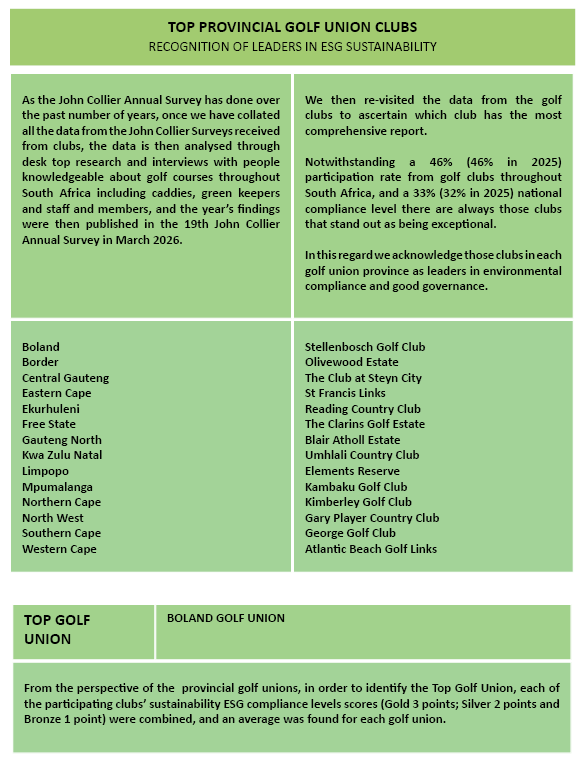
Atlantic Beach sets the bar: If the survey has a face for 2026, it is Atlantic Beach Golf Links, this year’s winner of the Sustainability ESG Top Club Award.
The judging panel pointed to a specific combination of factors: a genuine infrastructure commitment to solar, wetland preservation and smart water management systems that go beyond compliance theatre, and a Vision 2030 framework that ties environmental action to the club’s broader identity, rather than treating it as a side initiative.
What stood out most, was the club’s simultaneous integration of its activities across all three sustainability ESG pillars.
Furthermore, Stellenbosch Golf Club and Arabella Estate both received special mentions for their own sustainability ESG efforts.
Is sustainability ESG gaining ground within South African golf?
The answer to this question is an unequivocal, yes, and sustainability ESG is transitioning from a voluntary “nice-to-have” marketing badge to an absolute operational necessity in South Africa.
The momentum is driven by three distinct factors: The evolution of governance excellence through for example King V (The “G” in ESG), the shift from “Club to Hub” through social responsibility (The “S” in ESG) and hard environmental realities underpinning environmental stewardship (The “E” in ESG)
What one can take away from this: Stepping back from the year-on-year numbers and a clearer picture takes shape.
South African golf is not undergoing a sudden sustainability ESG transformation. It is undergoing something slower and, arguably, more durable: a gradual, compounding shift where clubs that commit to the process tend to keep climbing, and where the leadership cohort at gold level keeps refreshing itself rather than calcifying.
For now, the trajectory is positive, the leadership stories like Atlantic Beach Golf Links are genuinely worth celebrating, and the survey itself remains one of the few honest mirrors South African golf has for measuring how it’s doing on the issues that will define the sport’s next decade. Most importantly, the John Collier research data doesn’t imply failure; it outlines a classic pioneer phase. The gradual migration of clubs into the gold category proves the John Collier methodology works.
The challenge, for the South African golf industry over the next few years is twofold: firstly, to encourage the top 46% of clubs which are already involved to improve on certain of their sustainability ESG metrics, and secondly to help to encourage the remaining 54% of clubs, which are currently sitting on the sidelines, to participate.
THE COMPLETE RESULTS OF THE 2025 / 2026 JOHN COLLIER GOLF ESG SURVEY ARE AS FOLLOWS:

NATIONAL TOP CLUB AWARD
As has become the norm, there were a number of very strong contenders, however, we take this opportunity to congratulate, ATLANTIC BEACH LINKS on winning the SUSTAINABILITY ESG TOP CLUB AWARD in the John Collier Survey Report Review for 2025 – 2026, which is underpinned by the three pillars of sustainability namely, environmental stewardship, social responsibility and governance excellence (ESG)
The work being done at ATLANTIC BEACH is really impressive, and it is fitting that on World Environment Day, the club’s efforts were appropriately recognised.
World Environment Day (WED) is celebrated annually on 5 June, and its key objectives are to increase awareness about the environment, enhance political attention and encourage public action.
WED was established by the United Nations General Assembly in 1972, and over five decades, it has grown exponentially, and is now one of the largest global platforms for environmental outreach, with tens of millions of people participating online and through in-person activities, events, and actions around the world.
In this regard the John Collier Top Sustainability ESG Golf Club Award is registered on the United Nations WED site, and Atlantic Beach will receive international recognition for its achievement.
The underlying message for WED 2026 is no longer whether change is coming, but rather how effectively, and rapidly, governments, businesses and communities can guide it.
In this regard, what ATLANTIC BEACH did so well, in their survey questionnaire, for example, was to illustrate its commitment in terms of infrastructure transformation towards the implementation of solar, strengthening nature-based climate resilience, through wetland preservation and smart water management systems.
This understanding was further demonstrated by the club’s updating its strategic trajectory under its Vision 2030 framework.
The club’s vision is for a secure, dynamic community that embodies the true meaning of ‘home’, which offers exceptional experiences, and where lifestyle, sustainability, and community come together.
In addition, to achieve its Vision 2030 goals, the executive management and board have set specific operational values, which give effect to the ESG pillars.
For example, in terms of “E”, an operational environmental management programme is in place, in terms of “S” Atlantic Beach is committed to open communication and transparency and recognising staff as the heart of operational excellence, and with “G” it has a rolling five-year strategic financial plan, and well-established governance policies, procedures, and practices.
Atlantic Beach’s understanding, and implementation of the three pillars of sustainability – environmental stewardship, social responsibility, and governance excellence (ESG) – sets a standard that many clubs in South Africa would want to emulate.
Notwithstanding Atlantic Beach’s award, special mention must also be made of the Stellenbosch Golf Club and Arabella Golf Club, in their efforts towards sustainability and its three ESG pillars.
Winning a SUSTAINABILITY ESG TOP CLUB AWARD is only achieved with the wholehearted support of very committed and passionate people, who are prepared to wholly embrace sustainability, and its three ESG pillars, in an integrated and methodical manner.
Therefore, special congratulations must go to Atlantic Beach Links, the club’s members, the chairperson and governing body, the general manager Francois Swart, Tony Louw, Albert Clack, and the golf course superintendent Jaques van der Westhuizen.

If you have any questions, please do not hesitate to email ajcollier@telkomsa.net or visit the John Collier Golf website at www.johncolliergolf.com